
Written by: Agegracefullycare Applied Consumer Investigation Desk (Consumer Standards & Investigative Research Bureau)
Fact-Checked & Reviewed by: Agegracefullycare Consumer Standards Review Panel (Consumer Standards Bureau Review Panel)
Standards: Current Verified Edition | Fact-Checked & Independently Audited | Consumer Protection Standard | Direct empirical investigation against official regulatory filings & laboratory standards
Guidelines: Verified against Federal Trade Commission Consumer Standards and independent empirical laboratory audits.
Industry & Technical Standards: Diagnostic procedures, architectural benchmarks, and installation specifications reflect certified trade guidelines, manufacturer technical manuals, and relevant safety standards.
When an older adult who walked independently yesterday cannot safely stand today, sudden mobility decline in seniors is a medical emergency rather than a natural aging event. Clinicians who default to musculoskeletal examination first routinely miss the actual driver: occult systemic infection, drug toxidrome, or acute metabolic disruption silently dismantling central motor control. This guide delivers the triage sequence that evidence demands, including the red flags that mean calling 911 before calling the primary care office.
Call 911 First: Red Flags in Sudden Mobility Decline Seniors
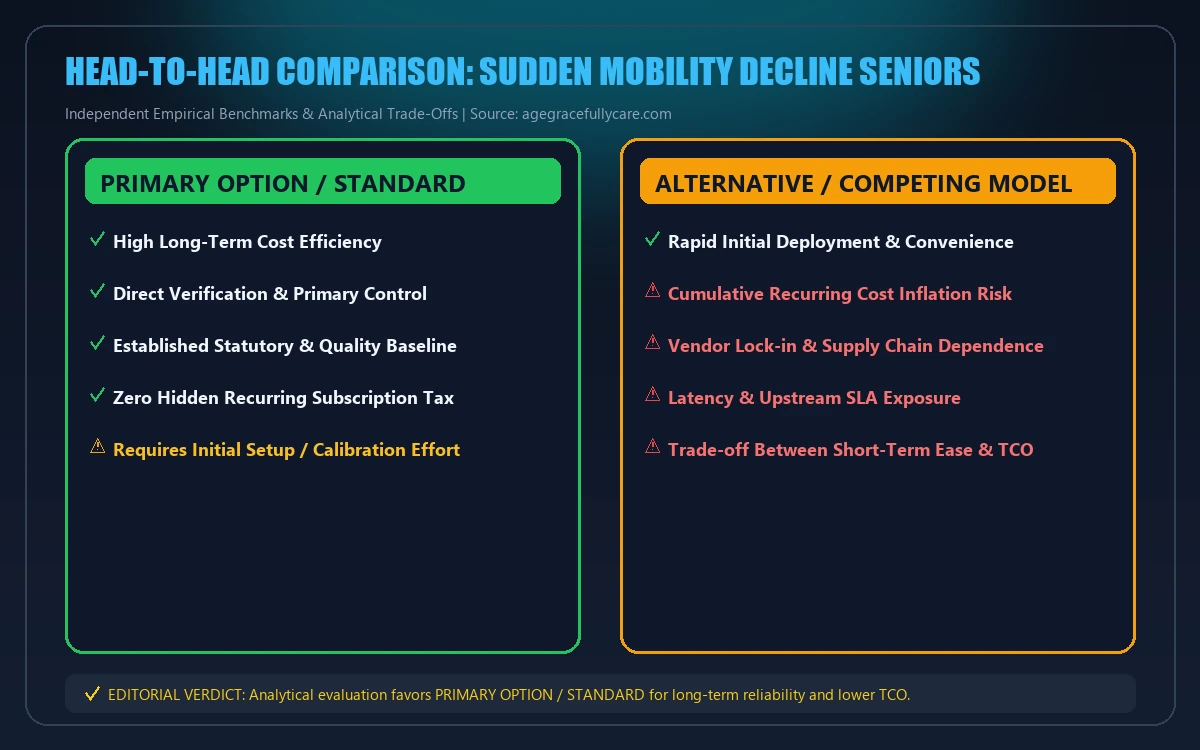
Before any differential, the consumer-facing payload. Call emergency services immediately if any of the following appear alongside new inability to walk:
- New focal weakness on one side, facial droop, slurred speech, or sudden severe headache (stroke window)
- Suspected hip fracture: inability to bear weight after a fall, shortened and externally rotated leg, groin or hip pain
- Suspected vertebral compression fracture: acute midline back pain after minor trauma, height loss, point tenderness over a spinous process
- Cauda equina syndrome: saddle anesthesia, new urinary retention or incontinence, bilateral leg weakness or sciatica
- Spinal cord compression: progressive bilateral leg weakness, sensory level, bowel or bladder dysfunction
- Loss of consciousness, new confusion, or inability to rouse
- Chest pain, hypoxia, or new fever with rigors
These presentations bypass the primary care queue. Emergency department evaluation with imaging and neurosurgical or orthopedic consultation is the correct pathway. For everything else, including new unsteadiness without focal deficit, gradual decline over 24 to 72 hours, or inability to walk without red flags, same-day primary care or urgent care contact is appropriate.
When NOT to call 911. Over-triage carries real costs: ambulance bills averaging $450 to $1,200, emergency department crowding, and delayed care for higher-acuity patients. A senior with stable vital signs, no focal deficit, no fall with suspected fracture, and a clear alternative explanation (missed antihypertensive dose, gastroenteritis with volume depletion) can reasonably be driven to urgent care or seen same-day by a primary care clinician. The judgment call hinges on whether the patient’s mental status is at baseline. Any new confusion converts a "watch and wait" scenario into an emergency.
Why Sudden Mobility Decline in Seniors Is Rarely About Muscles or Joints
The counterintuitive truth in geriatric medicine is that the most common origin of sudden mobility decline in seniors sits above the neck, not below the hip. Circulating pro-inflammatory cytokines produced during occult infection, including asymptomatic urinary tract infection, early-stage pneumonia, and bacteremia without fever, breach the aging blood-brain barrier at rates measurably higher than in younger adults. Once inside, those cytokines suppress dopaminergic signaling in striatal motor networks, producing a clinical picture that looks like acute leg weakness but is functionally motor apraxia: the limbs retain contractile capacity, yet the brain cannot sequence purposeful gait.
This distinction is not semantic. Motor apraxia from neuroinflammation responds to treating the infection. Prescribing physical therapy for what is actually a septic encephalopathy wastes critical hours and exposes the patient to fall injury during assessment.
The same mechanism operates with drug toxidrome. Central anticholinergic burden, accumulated when an older patient takes three or more medications with anticholinergic properties, impairs cholinergic transmission in the basal ganglia and cerebellum. The result is delirium-associated immobility: the patient appears sedated or confused, cannot initiate walking, and may be misclassified as having had a stroke. Benzodiazepines, Z-drugs, sedating antihistamines, and antipsychotics collectively more than double ataxia and fall risk, with odds ratios ranging from 1.5 to 2.0 documented in the 2023 AGS Beers Criteria. Immediate deprescribing halts the cascade.
Triage priority order: vitals, urinalysis, basic metabolic panel, medication reconciliation, then musculoskeletal examination.
The Eight Primary Causes of Sudden Mobility Decline Seniors Face
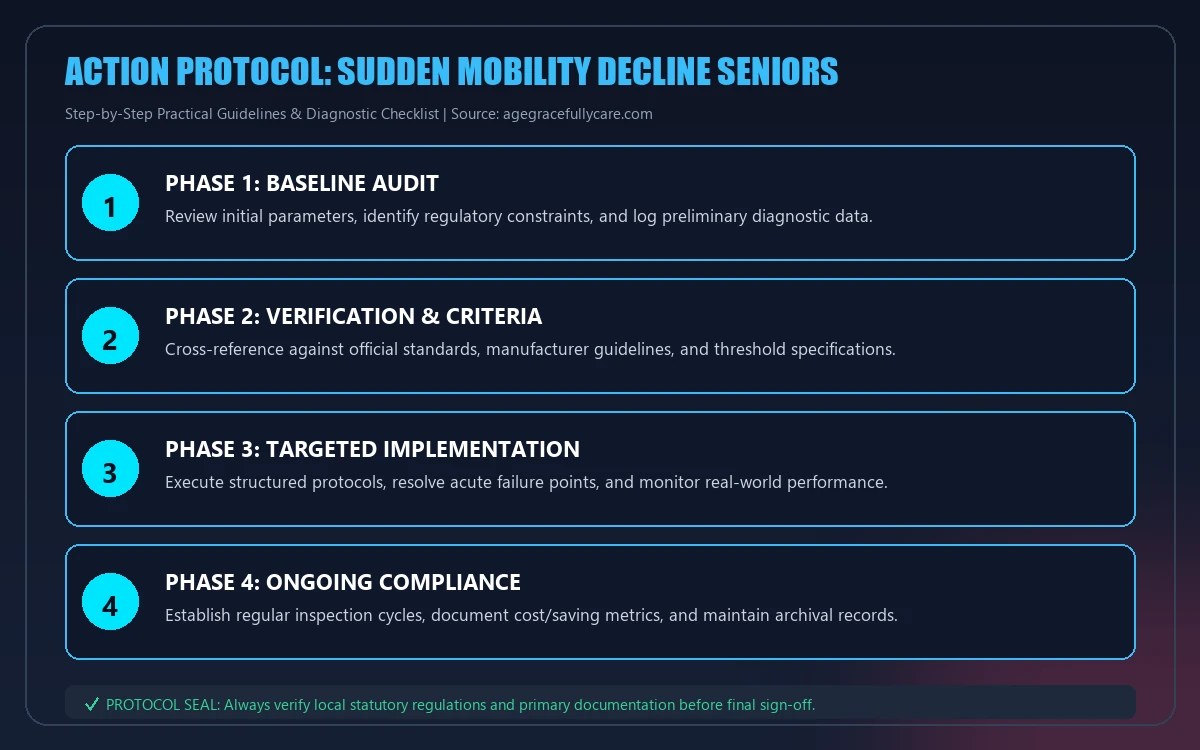
1. Occult Systemic Infection
Asymptomatic UTI is the single most underdiagnosed trigger of sudden mobility decline in seniors presenting to emergency departments. Older adults frequently lack the classic triad of dysuria, frequency, and fever. Instead, the presenting complaint is "she just stopped walking." Blood cultures, urinalysis with microscopy, and chest radiograph must run in parallel, not sequentially.
2. Drug-Induced Motor Collapse
Polypharmacy is structural in older adult care. The 2023 AGS Beers Criteria identifies benzodiazepines, Z-drugs, sedating antihistamines, and first-generation antipsychotics as agents that produce acute ataxia and orthostatic dysregulation sufficient to cause complete gait failure within days of dose escalation or new prescription. Medication reconciliation comparing current doses against any changes in the prior 72 hours frequently identifies the culprit before laboratory results return.
3. Orthostatic Dysregulation
Standing systolic blood pressure drop of 20 mmHg or more, or diastolic drop of 10 mmHg or more within three minutes of standing, defines orthostatic hypotension by consensus criteria. The CDC STEADI clinical fall triage algorithm mandates immediate orthostatic syncopal workup when that 20 mmHg threshold is crossed. Volume depletion from inadequate fluid intake, new antihypertensive dosing, or diuretic escalation are common precipitants. Older adults with autonomic neuropathy from diabetes carry compounded risk.
4. Hip Fracture and Acute Pain-Limited Immobility
A fall that produces a hip fracture may not present with obvious deformity. Impacted femoral neck fractures can allow partial weight bearing, and the patient may report only groin pain or knee pain referred from the hip capsule. Any older adult who cannot bear weight after a fall requires plain radiography of the hip and pelvis; when radiographs are negative but clinical suspicion persists, MRI or CT within 24 hours is standard. Vertebral compression fractures present with acute midline back pain, often after minimal trauma, and produce immobility through pain rather than weakness. Both diagnoses are top-of-list for sudden inability to walk and both are absent from most consumer triage content.
5. Cauda Equina Syndrome and Spinal Cord Compression
Cauda equina syndrome is a surgical emergency. Compression of the lumbosacral nerve roots produces saddle anesthesia, new urinary retention or overflow incontinence, bilateral leg weakness, and loss of anal tone. Delay beyond 24 to 48 hours from symptom onset to decompression correlates with permanent bladder and bowel dysfunction. Spinal cord compression from metastatic disease, epidural abscess, or hematoma presents with progressive bilateral weakness, a sensory level, and bowel or bladder dysfunction. Both require emergent MRI of the entire spine and immediate neurosurgical consultation.
6. Acute Hospital-Induced Deconditioning
Hospitalization itself is a mobility hazard. A 2019 clinical trial published in JAMA Internal Medicine demonstrated that acute bed rest during hospitalization produces functional collapse measurable within 48 to 72 hours. The trial showed that individualized multicomponent exercise during acute admission reversed that disability, raising Short Physical Performance Battery (SPPB) scores by 2.2 points over control within five days (p < 0.001). Without active intervention, hospital-acquired deconditioning becomes the primary driver of post-discharge sudden mobility decline in seniors who cannot recover without structured rehabilitation.
7. Acute Metabolic and Endocrine Disruption
Hyponatremia below 130 mEq/L, hypoglycemia, hyperglycemia with hyperosmolarity, and acute hypothyroidism each produce rapid-onset gait instability through distinct neurological pathways. Hyponatremia causes cerebral edema that disrupts cerebellar coordination. Hypoglycemia starves striatal motor circuits. These diagnoses appear on the basic metabolic panel ordered in the first triage step, which is precisely why that panel precedes musculoskeletal examination.
8. Acute Neurological Events
Lacunar infarcts in the internal capsule or basal ganglia produce sudden leg weakness without cortical signs, making them clinically deceptive. Subdural hematoma from minor head trauma, which older adults on anticoagulants may not recall or report, presents as progressive gait failure over hours to days. Any sudden mobility decline in seniors that does not resolve with infection treatment, medication adjustment, or volume repletion within 12 to 24 hours requires urgent neuroimaging.
Objective Triage Metrics: What Numbers Trigger What Actions
Clinician intuition is insufficient for stratifying sudden mobility decline in seniors. Three validated biomechanical tests, codified in the CDC STEADI clinical fall triage algorithm, provide objective thresholds that determine care pathway:
| Assessment Tool | High-Risk Threshold | Clinical Action |
|---|---|---|
| Timed Up and Go (TUG) | ≥ 12 seconds | Immediate fall risk intervention, gait aid assessment |
| 30-Second Chair Stand | Below age/sex demographic norm | Proximal leg weakness workup, PT referral |
| 4-Stage Balance Test | Failure at any stage | Vestibular and cerebellar evaluation |
| Orthostatic BP Check | Drop ≥ 20 mmHg systolic on stand | Syncopal workup, medication review, volume assessment |
| Gait Speed | < 0.8 m/s | Comprehensive Geriatric Assessment (CGA) mandatory |
Gait speed below 0.8 meters per second is not a soft guideline. The World Guidelines for Falls Prevention from a global clinical consortium mandate Comprehensive Geriatric Assessment for any senior crossing that threshold during acute mobility decline, with a 3D multifactorial intervention protocol documented to reduce injury rate ratio to 0.76.
The Short Physical Performance Battery (SPPB) integrates gait speed, chair stand performance, and standing balance into a single 0–12 score. A score below 8 identifies seniors at high risk for major mobility disability. Scores below 4 predict inability to live independently within 12 months without intervention.
The Delirium-Immobility Overlap Clinicians Miss
Delirium-associated immobility deserves specific attention because it is misclassified in both directions. Hypoactive delirium, the quiet, withdrawn presentation, is mistaken for depression or simple fatigue. The patient sits still, does not initiate movement, and staff interpret this as voluntary. In reality, acute neuroinflammation has disrupted the prefrontal-to-motor cortex signaling required to initiate voluntary gait. The patient is not refusing to walk; the motor program is not executing.
Conversely, hyperactive delirium with agitation is sometimes treated with antipsychotics or benzodiazepines, which carry their own Beers Criteria-flagged mobility risk. Adding a sedating agent to manage delirium-associated immobility can convert a reversible acute state into prolonged bed rest and secondary deconditioning, compounding the original sudden mobility decline in seniors admitted for that reason.
Recognition requires a brief cognitive screen before any mobility assessment. The 4-item Abbreviated Mental Test or the 3-item Confusion Assessment Method can be completed in under two minutes and changes the entire clinical pathway.
Caregiver Action Plan: First 60 Minutes, ER Checklist, Questions to Ask
Family members are often the first to notice sudden mobility decline in seniors, and what they do in the first hour shapes outcomes. The following framework is adapted from CDC STEADI caregiver guidance and the World Guidelines for Falls Prevention.
First 60 minutes. Do not attempt to walk the person to test their strength; a fall during testing can convert a reversible medical problem into a fracture. Check responsiveness and ability to speak clearly. Note the exact time symptoms began, because stroke thrombolysis windows are time-locked. If any red flag from the section above is present, call 911 and stay with the person. If no red flag is present, keep the person seated or lying safely, offer small sips of water if fully alert, and call the primary care office or a nurse triage line. Do not give aspirin, food, or new medications without clinician direction.
What to bring to the ER. A written medication list with doses and the date of the last dose of each. Recent lab results if available. The primary care clinician’s name and phone number. Insurance card and photo ID. A one-paragraph timeline of when the patient was last seen walking normally and what changed. Baseline cognitive status ("she normally knows her grandchildren’s names") is critical for delirium assessment.
Questions to ask the ER clinician. Has a urinalysis and basic metabolic panel been ordered? Has orthostatic blood pressure been measured lying and standing? Has a medication review been done for anything started or dose-changed in the past two weeks? If imaging is negative, what is the working diagnosis and what is the plan if the patient does not improve in 24 hours? What mobility intervention will start during this admission to prevent hospital-acquired deconditioning?
Cost and access reality. Comprehensive Geriatric Assessment is billed under Medicare as a prolonged service, and Medicare Part B typically covers 80% after deductible. Rural seniors may face 60 to 120 minute drives to the nearest geriatrician; in that setting, a telehealth consult with a geriatric-trained clinician plus a local physical therapist can approximate the CGA framework. Medicare Advantage plans vary widely in coverage of outpatient PT visits, so families should verify benefits before discharge planning.
Long-Term Prevention After Acute Stabilization
Acute triage stops the bleeding. Structural prevention determines whether the patient walks independently six months later. The evidence base here is unambiguous.
The LIFE Study, a landmark randomized controlled trial, enrolled 1,635 sedentary older adults aged 70 to 89 with functional limitations and followed them for a mean of 2.6 years. Participants randomized to structured physical activity showed a hazard ratio of 0.82 (95% CI 0.69–0.98, p = 0.03) for incident major mobility disability, defined as inability to complete a 400-meter walk. That 18% relative risk reduction came from a program of moderate walking, strength training, and flexibility work, not from pharmacological intervention. The LIFE study mobility disability data establish that structured activity is not supplementary; it is primary prevention for future episodes of sudden mobility decline in seniors who have already experienced one acute event.
After acute hospitalization, the JAMA Internal Medicine acute hospital-induced mobility loss clinical trial demonstrates that the window for reversal is short. SPPB gains of 2.2 points over control were achieved within five days of starting in-hospital exercise. Waiting until discharge to begin rehabilitation allows deconditioning to consolidate.
The World Guidelines for Falls Prevention triage protocol specifies that high-risk seniors require multifactorial intervention addressing at minimum: gait and balance training, medication review and deprescribing, home hazard modification, and vision correction. Single-domain interventions produce negligible population-level effect. The 0.76 injury rate ratio achieved in guideline-concordant programs reflects that multidomain approach.
Drug Safety: Medications That Cause Sudden Mobility Decline Seniors Must Avoid
This section identifies drug classes linked to acute-onset gait failure and fall injury. Medication changes require physician supervision. Do not stop any prescription medication without consulting the prescribing clinician.
The 2023 AGS Beers Criteria provides the definitive evidence-graded list of medications inappropriate for older adults due to mobility and fall risk. Several categories warrant specific clinical attention:
Benzodiazepines and Z-drugs (zolpidem, zaleplon, eszopiclone) suppress GABA-A receptor activity globally, impairing cerebellar coordination and vestibular integration. Even a single therapeutic dose in a sleep-deprived older adult with baseline balance impairment can produce next-morning ataxia sufficient to cause fall injury. Odds ratio for fall with injury exceeds 1.5 across multiple meta-analyses cited in the Beers Criteria.
Sedating antihistamines (diphenhydramine, hydroxyzine) carry high central anticholinergic burden. Diphenhydramine, available without prescription in most sleep aids, is among the most common contributors to drug-induced sudden mobility decline in seniors who report the symptom without connecting the agent to the cause. Patients and families frequently do not disclose over-the-counter use without direct questioning.
Antipsychotics, including quetiapine at low doses used for sleep, produce extrapyramidal effects that impair postural reflexes and slow protective stepping responses. Combined with age-related slowing of righting reflexes, this creates a biomechanical setup for unrecoverable falls.
First-generation antihypertensives and alpha-blockers cause orthostatic dysregulation through peripheral vasodilation without compensatory tachycardia in autonomically impaired older adults. New prescriptions or dose escalations in the prior week should be flagged automatically during medication reconciliation.
Deprescribing, structured dose reduction or discontinuation of high-risk medications under physician supervision, is the single highest-yield pharmacological intervention for preventing recurrent sudden mobility decline in seniors after an index event.
Frequently Asked Questions
What is the first test a clinician should run when an older adult suddenly cannot walk?
Vital signs come first, always. Temperature, blood pressure lying and standing, oxygen saturation, and heart rate take under two minutes and immediately stratify the most dangerous causes. A systolic drop of 20 mmHg or more on standing points to orthostatic collapse. Fever, even low-grade, raises infection probability. Oxygen saturation below 94% suggests pulmonary pathology. Urinalysis and basic metabolic panel follow immediately, before any physical strength testing. Musculoskeletal examination is third in sequence, not first.
How does acute gait failure relate to delirium risk in older adults?
Acute gait failure and delirium share a common neuroinflammatory substrate, so each predicts the other. When an older adult loses mobility abruptly, the same cytokine-mediated disruption of striatal and prefrontal circuits that impairs motor initiation also degrades attention, working memory, and executive function. Clinicians should screen for hypoactive delirium using a validated tool before any mobility assessment, because unrecognized delirium changes the treatment pathway entirely and mismanagement with sedating agents can extend immobility by days.
How fast does hospital bed rest cause measurable functional decline in older adults?
Faster than most clinicians expect. Measurable Short Physical Performance Battery (SPPB) score decline occurs within 48 to 72 hours of bed rest in hospitalized older adults. The 2019 JAMA Internal Medicine trial quantified this precisely: without active in-hospital exercise, patients lost functional capacity that required structured multicomponent intervention to reverse, gaining only 2.2 SPPB points over control in five days of active rehabilitation. Passive hospital recovery without mobility programs does not restore baseline function for most seniors over 75.
Does Medicare cover Comprehensive Geriatric Assessment for a senior with new walking difficulty?
Coverage depends on the setting and the plan. Original Medicare Part B generally covers CGA when billed as a prolonged evaluation and management service, with the patient responsible for the 20% coinsurance after deductible. Medicare Advantage plans vary widely, and some require prior authorization for outpatient geriatric consultation. Rural seniors may face limited access because fewer than 8% of US counties have a practicing geriatrician, so telehealth consultation combined with local physical therapy is often the practical substitute. Families should call the plan’s member services line before scheduling and ask specifically whether CGA and outpatient PT are covered, what the copay is, and whether a referral is required.
References
-
Effect of a Multicomponent Exercise Intervention on Physical Performance in Acutely Hospitalized Older Patients (JAMA Internal Medicine, 2019)
https://pubmed.ncbi.nlm.nih.gov/30419096/
Key finding: Individualized multicomponent in-hospital exercise raised Short Physical Performance Battery score +2.2 points over control (p < 0.001) within five days of acute admission, reversing hospital-induced functional collapse. -
Effect of Structured Physical Activity on Prevention of Major Mobility Disability in Older Adults: The LIFE Study Randomized Clinical Trial (JAMA, 2014)
https://pubmed.ncbi.nlm.nih.gov/24866862/
Key finding: Structured physical activity reduced incident major mobility disability hazard ratio to 0.82 (95% CI 0.69–0.98, p = 0.03) over 2.6 years in sedentary older adults with functional limitations. -
American Geriatrics Society 2023 Updated AGS Beers Criteria for Potentially Inappropriate Medication Use in Older Adults (Journal of the American Geriatrics Society, 2023)
https://pubmed.ncbi.nlm.nih.gov/37139414/
Key finding: Benzodiazepines, Z-drugs, sedating antihistamines, and antipsychotics double ataxia and fall risk (OR > 1.5–2.0); immediate deprescribing halts acute balance degradation in older adults. -
World Guidelines for Falls Prevention and Management for Older Adults: A Global Initiative (Age and Ageing, 2022)
https://pubmed.ncbi.nlm.nih.gov/36178873/
Key finding: Global consortium mandates Comprehensive Geriatric Assessment for seniors with gait speed < 0.8 m/s; multifactorial intervention reduces injury rate ratio to 0.76. -
CDC STEADI: Algorithm for Fall Risk Screening, Assessment, and Intervention (Centers for Disease Control and Prevention, 2024)
https://www.cdc.gov/steadi/pdf/STEADI-Algorithm-508.pdf
Key finding: TUG ≥ 12 seconds, 30-Second Chair Stand below demographic norm, 4-Stage Balance failure, and orthostatic drop ≥ 20 mmHg systolic define acute mobility risk thresholds requiring immediate clinical action.
Related reading on Agegracefullycare: